Showing posts with label World News. Show all posts

U.N. condemns North Korea launch, warns on nuclear test


UNITED NATIONS (Reuters) - The U.N. Security Council on Monday strongly condemned North Korea's rocket launch, urged tightening of existing U.N. sanctions and warned Pyongyang of further consequences if it carries out another missile launch ornuclear test.
China, a permanent veto-wielding council member and North Korea's protector on the 15-nation panel, backed the council's "presidential statement," which was adopted unanimously.

U.N. diplomats said the council's relatively quick agreement on a declaration condemning Pyongyang signaled Beijing's irritation with its hermit neighbor over a satellite launch last week that North Korea had been widely urged not to carry out.
"The Security Council strongly condemns the 13 April 2012 (local time) launch by the Democratic People's Republic of Korea (DPRK)," the statement said.
"The Security Council demands that the DPRK (North Korea) not proceed with any further launches using ballistic missile technology and comply with (Security Council) resolutions ... by suspending all activities related to its ballistic missile program," it said.
The council declaration also demands that North Korea "abandon all nuclear weapons and existing nuclear programs in a complete, verifiable and irreversible manner ... and not conduct any further launches that use ballistic missile technology, nuclear tests or any further provocation."
It concludes with a warning to Pyongyang that the council is prepared to take further steps if necessary.
"The Security Council expresses its determination to take action accordingly in the event of a further DPRK launch or nuclear test," it said.
U.S. Ambassador to the United Nations Susan Rice, who is the Security Council president this month, told reporters that Monday's decision showed how united the world was.
"The swift and unanimous adoption of this strong presidential statement shows that the international community is united in sending a clear message to North Korea that such provocations are serious and totally unacceptable," she said.
"The Security Council made clear that there will be consequences for any future North Korean launch or nuclear test," she said.
She said the statement was tougher than one the council issued after North Korea's April 2009 missile launch. The 2009 statement said the council "condemns" the launch, while Monday's declaration said it "strongly condemns" Pyongyang.
"DISASTROUS COURSE"
Rice described the council statement as calling for "new sanctions," though what it actually urges is an expansion of the list of firms, individuals and goods the Security Council blacklisted after North Korea's 2006 and 2009 nuclear tests.
Under those measures, North Korea is banned from using, developing or importing ballistic missileand nuclear technologies.
Rice said the U.S. delegation would soon propose a "robust package" of names of individuals and companies to be added to the existing U.N. blacklist, along with additional goods that North Korea would be banned from importing.
The statement does not result in an immediate expansion of the North Korea sanctions regime. Rather it instructs the U.N. sanctions committee to expand its existing sanctions blacklist within 15 days and to review that list annually.
The committee, which includes all 15 council members and works on the basis of consensus, will have to take a separate decision on expanding the U.N. blacklist. China will therefore have an opportunity to thwart any push for adding new names to the North Korea sanctions list if it chooses to do so.
Asked whether she expected Pyongyang to explode another atomic device in defiance of the council, Rice said North Korea followed its 2006 and 2009 missile launches with nuclear tests.
"Clearly the potential for that pattern to persist is one that all members of the international community are mindful of and think would be a disastrous course for the North to pursue," she said. "It will only lead to the North's increased isolation."
North Korea admitted its long-range rocket failed to deliver a satellite into orbit on Friday while U.S. and South Korean officials said it crashed into the sea a few minutes after launch.
While the statement called for tightening existing U.N. sanctions, diplomats said no council member had seriously pushed the idea of imposing new sanctions on Pyongyang in retaliation for the launch, something China and Russia would have opposed.
The existing U.N. blacklist of sanctioned firms and individuals includes those linked to Pyongyang's nuclear and missile industries.
(Additional reporting by Michelle Nichols; Editing by Eric Beech and Jackie Frank)

Citi profit tops expectations, bond trading helps


(Reuters) - Citigroup Inc posted stronger-than-expected first-quarter results as bond trading and underwriting revenue jumped compared with the 2011 fourth quarter.
While the results were better than the company's report three months ago, profit fell 2 percent from a year earlier, reflecting the bank's difficulties as it works to boost its earnings in a sluggish global economy.

Chief Executive Vikram Pandit said the bank might not seek regulatory approval to return capital to shareholders this year after all. Citigroup received multiple bailouts during the credit crunch and was one of the few banks to have its capital return plans rejected by the Federal Reserve earlier this year.
First-quarter revenue, excluding accounting adjustments, was up 1 percent from a year earlier and 17 percent from the fourth quarter, to $20.2 billion. Investment banking revenue was hit particularly hard in North America and Europe.
Investors focused on the positives, and Citigroup's shares rose 74 cents, or 2.2 percent, at $34.15 in Monday afternoon trading.
"They continue to progress. They have headwinds that maybe only Bank of America has, but they seem to be managing those headwinds," said Gary Townsend, CEO of Hill-Townsend Capital. "It's a good quarter without being as superlative as JPMorgan's was."
JPMorgan Chase & Co topped Wall Street profit expectations on Friday, helped by some of the same macro trends - a better economy and more active capital markets.
But the KBW index of bank stocks <.BKX> is already up more than 20 percent this year, and investors are turning their attention to determining the strength and extent of the recovery, which still lags the optimism of early last year.
Citigroup Chief Financial Officer John Gerspach said demand for loans remains soft in the United States and Europe but continues to be strong in emerging markets.
Loan growth in the first quarter was particularly strong for trade finance, he added in a conference call with reporters.
At the end of the first quarter, the bank had $619 billion of loans outstanding, after accounting for money set aside for bad loans. That was up from $617.13 billion at the end of the fourth quarter and $600.57 billion a year earlier.
LAGGING ON CAPITAL PLAN
Last month, Citigroup was one of only a handful of large financial institutions that failed to win approval from regulators for a dividend increase or share buyback.
Analysts have wondered if Citigroup asked to distribute too much capital or somehow erred in its calculations of the losses it would incur under stress tests conducted by the regulators.
In the weeks leading up to the setback for the capital plan, Pandit convinced analysts that Citigroup had rebuilt its balance sheet to the point that it had so much more capital than needed in an economic downturn that it would to be allowed to raise its quarterly dividend from a nominal penny a share to as much as 10 cents.
On Monday, Pandit said Citigroup was due to submit a new proposal by mid-June for managing its balance sheet to withstand hypothetical financial stresses.
New economic and market scenarios may be applied in the next review, he said, explaining that the bank is still discussing the retest with Federal Reserve officials.
Pandit told analysts on a conference call that the company may opt not to ask regulators for permission to raise the dividend or buy back stock this year.
"We need to understand the process going forward to make a determination what to include in our submission," he said.
The CEO also said the company's capital is increasing quickly enough that it does not have to sell its minority interest in its brokerage joint-venture with Morgan Stanley .
The new test will be based on Citigroup's March 31 balance sheet, which is stronger than at the end of December, before the earlier test.
For example, Citigroup's so-called Tier 1 Common Ratio, a measure used under Basel 1 regulations, rose to 12.4 percent from 11.8 percent. And its ratio as measured under pending new Basel 3 regulations is on track to rise above 8 percent at the end of the year from its current 7.2 percent.
Pandit cautioned that the Federal Reserve looks at different capital figures than those used for Basel.
Once the bank submits a new plan for 2012, the Federal Reserve has 75 days to respond, which means the company may not get an answer until well into the third quarter of the year and not long before it has to start preparing to have its 2013 capital plan tested.
Pandit said the bank would announce by its July earnings conference call whether it was seeking to return more capital to shareholders.
In the first quarter, a set of assets the company has been selling off or running down since the financial crisis declined 29 percent from a year earlier to $209 billion, or 11 percent of total Citigroup assets.
NET INCOME FALLS
Citigroup's first-quarter net income fell 2 percent to $2.93 billion, or 95 cents a share, from $2.99 billion, or 99 cents a share, a year earlier.
Excluding the impact of certain accounting adjustments for changes in the value of debts and credits, Citigroup earned $1.11 a share. The average Wall Street forecast was $1.00, according to Thomson Reuters I/B/E/S.
Revenue from the company's ongoing securities trading and investment banking business declined 12 percent from the strong quarter a year earlier but rose 65 percent from the weak 2011 fourth quarter.
Expenses were down 7 percent from the previous quarter and were flat with a year earlier, reflecting seasonal factors and the company's commitment to bring costs down for the year, Gerspach said in the conference call.
Citigroup's 2011 fourth-quarter earnings missed analysts' estimates and executives were grilled over the company's control of its expenses, which rose 4 percent in the fourth quarter from the third quarter. Expense control has become an increasingly important issue for banks because their profits are being squeezed by low interest rates and tighter regulation.
The bank's latest results were boosted by a $1.2 billion release of bad-loan reserves. Delinquency rates for its North American credit card and retail banking customers declined 31 percent from a year earlier. International consumer credit costs fell 3 percent.
(Reporting by David Henry in New York and Rick Rothacker in Charlotte, North Carolina. Editing by John Wallace and Paritosh Bansal.)

Shelling in Syria as UN monitors begin mission


BEIRUT (AP) — An advance team of U.N. observers was negotiating the ground rules with Syrian authorities Monday for monitoring the country's 5-day-old cease-fire, which appeared to be rapidly unraveling as regime forces pounded the opposition stronghold of Homs with artillery shells and mortars, activists said.
Even though the overall level of violence across Syria has dropped significantly since the truce took effect, government attacks over the weekend raised new doubts about President Bashar Assad's commitment to special envoy Kofi Annan's plan to end 13 months of violence and launch talks on the country's political future.

The advance team of six U.N. monitors arrived in Damascus Sunday night. Annan's spokesman said the team, led by Moroccan Col. Ahmed Himmiche, met Monday with Syrian Foreign Ministry officials to discuss ground rules, including what freedom of movement the observers would have. Ahmad Fawzi said the remaining 25 observers are expected to arrive in the coming days.
The Security Council demanded full freedom of movement for the U.N. team, but the regime could try to create obstacles. The failure of an Arab League observer mission earlier this year was blamed in part on regime restrictions imposed on the observers, including having to travel with government minders.
Fawzi said in a statement issued in Geneva on Monday that the mission "will start with setting up operating headquarters, and reaching out to the Syrian governmentand the opposition forces so that both sides fully understand the role of the U.N. observers."
"We will start our mission as soon as possible and we hope it will be a success," Himmiche told The Associated Press as he left a Damascus hotel along with his team Monday morning.
The international community hopes U.N. observers will be able to stabilize the cease-fire, which formally took effect Thursday, although pockets of violence have persisted, particularly in the central cities of Hama and Homs.
Tarek Badrakhan, an activist from the battered and almost deserted Homs district of Khaldiyeh, said the regime resumed its intense bombardment of the neighborhood early Monday for the third consecutive day.
"The shelling hasn't stopped for one minute since this morning. There are buildings on fire right now," he said via Skype.
Badrakhan and other activists said the army appeared to be on a push to take control of the last rebel-held districts in Homs and was pounding Khaldiyeh from three sides. He said half of the nearby district of Bayada fell under the army's control Sunday night. Troops were trying to storm Qarabees and Jouret al-Shayah but the Free Syrian Army is repelling them, he said, referring to the army defectors fighting the government.
"We hope that the observers would come to Homs as soon as possible because if things go on like this, there won't be anything left called Homs," Badrakhan said.
Two activist groups, the Local Coordination Committees and the British-based Syrian Observatory for Human Rights, confirmed the intense shelling of Homs and said two people were killed in the city of Hama in central Syria on Monday when security forces opened fire on their car.
Western countries and the Syrian opposition are skeptical Assad will abide by Annan's six-point plan for a cease-fire and the weekend pounding of Homs along with scattered violence in other areas has reinforced those doubts.
Assad accepted the truce deal at the prodding of his main ally, Russia, but his compliance has been limited. He has halted shelling of rebel-held neighborhoods, with the exception of Homs, but ignored calls to pull troops out of urban centers, apparently for fear of losing control over a country his family has ruled for four decades. Rebel fighters have also kept up attacks, including shooting ambushes.
Syria's state-run newspaper Tishrin said Monday that Damascus is "satisfied" with the U.N. resolution to send observers to the country because it respects Syrian sovereignty. The paper added that the resolution says all parties were responsible for halting violence. "This is a clear cut international recognition of the crimes and assaults committed by armed groups," it said.
The U.N. Security Council approved the observer mission unanimously on Saturday. A larger team of 250 observers requires more negotiations between the U.N. and the Syrian government next week.
U.N. Secretary-General Bank Ki-moon expressed serious concern with the Syrian government's continued shelling of Homs and said "the whole world is watching with skeptical eyes" whether the cease-fire can be sustained.
"It is important — absolutely important that the Syrian government should take all the measures to keep this cessation of violence," he told reporters in Brussels after meeting Belgian Prime Minister Elio Di Rupo on Sunday.
Ban said he hoped that once the full monitoring team is on the ground "there will be calm and stability and peace without any violence."
Since the cease-fire began, each side has accused the other of violations.
Syria's state-run news agency SANA has reported rebel attacks targeting checkpoints and army officers, while opposition activists said regime troops and their allied shabiha militiamen continued arrest raids and mistreatment of those in detention.
Also Monday, a Hamas official said a senior member of the Palestinian group, Mustafa Lidawi, was abducted over the weekend near Damascus. In the past, Lidawi had served as the Hamas representative in Iran and Lebanon.
Lidawi opposed a recent power-sharing agreement between the Islamic militant Hamas and its Western-backed rival, Palestinian President Mahmoud Abbas, and was seen as a supporter of Assad's regime. Until recently, Hamas' top leaders were based in Damascus, but became increasingly critical of Assad's crackdown on the uprising and decided to leave the country.
Hamas asked the Syrian authorities to try to find Lidawi, said a senior official of the group in the Hamas-run Gaza Strip, who spoke on condition of anonymity because of the sensitive nature of the contacts. Lidawi's family told Hamas officials he was abducted Saturday.
___
Associated Press writers Albert Aji in Damascus, John Heilprin in Geneva and Ibrahim Barzak in Gaza City, Gaza Strip contributed to this report.

Norway killer admits massacre, claims self-defense


OSLO, Norway (AP) — A right-wing fanatic admitted Monday to unleashing a bomb-and-shooting massacre that killed 77 people in Norway but pleaded not guilty to criminal charges, saying he was acting in self-defense.
On the first day of his long-awaited trial, Anders Behring Breivikdefiantly rejected the authority of the court as it sought to assign responsibility for the July 22 attacks that shocked Norway and jolted the image of terrorism in Europe.

Dressed in a dark suit and sporting a thin beard, Breivik smiled as a guard removed his handcuffs in the crowded court room. The 33-year-old then flashed a closed-fist salute, before shaking hands with prosecutors and court officials.
"I don't recognize Norwegian courts because you get your mandate from the Norwegian political parties who support multiculturalism," Breivik said in his first comments to the court.
Eight people were killed in Breivik's bombing of Oslo's government district and 69 others were slain in his shooting massacre at the left-leaning Labor Party's youth camp on Utoya island outside the capital.
"I admit to the acts, but not criminal guilt," he told the court, insisting he had acted in self-defense.
He remained stone-faced and motionless as prosecutors read the indictment on terror and murder charges, with descriptions of how each victim died, and when they explained how he prepared for the attacks.
But he suddenly became emotional when prosecutors showed an anti-Muslim video that he had posted on YouTube before the killing spree, wiping away tears with trembling hands.
Breivik also said he doesn't recognize the authority of Judge Wenche Elisabeth Arntzen, because he said she is friends with the sister of former Norwegian Prime Minister and Labor Party leader Gro Harlem Brundtland.
The anti-Muslim militant described himself as a writer, currently working from prison, when asked by the judge for his employment status.
Breivik has said the attacks were necessary to protect Norway from being taken over by Muslims. He claims he targeted the government headquarters in Oslo and the youth camp to strike against the left-leaning political forces he blames for allowing immigration in Norway.
While Norway has a principle of preventive self-defense in its law, that doesn't apply to Breivik's case, said Jarl Borgvin Doerre, a legal expert who has written a book on the concept.
"It is obvious that it has nothing to do with preventive self-defense," Doerre told The Associated Press.
The key issue to be resolved during the 10-week trial is the state of Breivik's mental health, which will decide whether he is sent to prison or into psychiatric care.
If deemed mentally competent, he would face a maximum prison sentence of 21 years or an alternate custody arrangement under which the sentence is prolonged for as long as an inmate is deemed a danger to society.
Police sealed off the streets around the Oslo court building, where journalists, survivors and relatives of victims watched the proceedings in a 200-seat courtroom built specifically for the trial.
Thick glass partitions were put up to separate the defendant from victims and their families, many of whom are worried that Breivik will use the trial to promote his extremist political ideology. In a manifesto he published online before the attacks, Breivik wrote that "patriotic resistance fighters" should use trials "as a platform to further our cause."
Norway's NRK television will broadcast parts of the trial, but it is not allowed to show Breivik's testimony.
He had told investigators he is a resistance fighter in a far-right militant group modeled after the Knights Templar — a Western Christian order that fought during the crusades — but police have found no trace of any organization and say he acted alone.
"In our opinion, such a network does not exist," Prosecutor Svein Holden told the court.
Anxious to prove he is not insane, he has called right-wing extremists and radical Islamists to testify during the trial, to show that there are others who share his view of clashing civilizations.
Breivik surrendered to police 1 hour and 20 minutes after he arrived on Utoya. The police response was slowed by a series of mishaps, including the lack of an operating police helicopter and the breakdown of an overloaded boat carrying a commando team to the island.
___
Associated Press writers Bjoern H. Amland and Julia Gronnevet contributed to this report.

U.N. peace monitors in Syria set to begin mission


BEIRUT (Reuters) - U.N. peace monitors are due to start their mission in Syria on Monday to oversee a shaky ceasefire undermined by persistent violence and the shelling of the opposition stronghold of Homs by forces loyal to President Bashar al-Assad.
The ceasefire is part of a broader peace plan brokered by international mediator Kofi Annan, but it looked increasingly under threat throughout the weekend as the government vowed a crackdown on a wave of "terrorist attacks" in Syria.

An advance team of five unarmed monitors arrived in the capital Damascus on Sunday evening, a Reuters witness said.
A Syrian official escorting the team at a Damascus hotel told Reuters that more observers were expected to arrive on Monday, but offered no details. Under the U.N. plan, two dozen more observers are due to enter Syria in coming days.
As the monitors prepared to embark on their mission, violence persisted on the ground.
One activist said the city of Homs, one of the hotbeds of opposition to Assad, was bombarded on Sunday by government forces at a rate of "one shell per minute".
Other activist sources said that six people had been killed on Sunday, and four bodies had been found.
Casting further doubt on whether the ceasefire would hold, Syria said it would stop what it called "terrorist groups" from committing criminal acts, state television reported.
Annan, joint special envoy of the United Nations and Arab League, brokered the six-point peace plan in March as part of international efforts to stop 13 months of violence.
The plan calls for the start of political dialogue, the delivery of humanitarian assistance, the release of prisoners including those involved in peaceful protests, freedom of movement for journalists to work throughout Syria.
The U.N. Security Council authorized the deployment of up to 30 unarmed observers on Saturday in the first resolution on Syria the 15-nation council managed to approve unanimously since the uprising erupted in March 2011.
VIOLENCE IN HOMS
Syria blames the violence on what it says are terrorists seeking to topple Assad. It has denied journalists access to the country, making it impossible to independently verify reports.
The U.N. estimates Assad's forces have killed more than 9,000 people in the uprising. Syria says foreign-backed militants have killed more than 2,500 soldiers and police.
On Sunday, the Syrian state news agency SANA said a "terrorist group" ambushed armed forces in Idlib province, killing a soldier and wounding three others.
"Since the announcement of an end to military operations, terrorist attacks have increased by dozens, causing a large loss of life," SANA added.
"(Security forces), based on their duty to protect civilians and the country, will stop terrorist groups from continuing their criminals acts and the killing of civilians," SANA said.
U.N. Secretary General Ban Ki-moon said he was concerned about the shelling of Homs and urged the Syrian government to refrain from any escalation of violence.
"While we welcome the cessation of violence at this time I warn that the whole world is watching with skeptical eyes whether this will be sustainable," he said. "It is important the Syrian government takes all the measures to keep the cessation of violence."
Annan's spokesman said the mission could be expanded to 250 or more but that would require another resolution.
Syrian government spokeswoman Bouthaina Shaaban said Syria could not be responsible for the safety of the monitors unless it was involved in "all steps on the ground".
On the eve of the mission, Syrian forces pounded Homs, activists said. "Early this morning we saw a helicopter and a spotter plane fly overhead. Ten minutes later, there was heavy shelling," said Walid al-Fares, a local activist.
Activist video footage, reportedly from Khalidiya, shows an explosion shortly after the sound of a missile flying through the air. Another whiz follows, and the cameraman, standing in a nearby building, pans across to show a ball of flames and smoke rising into the air.
(Writing by Alessandra Rizzo Editing by Maria Golovnina)

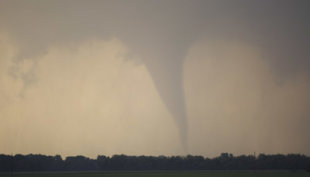
Midwest storms: Tornadoes reported in Midwest


Below are continuing updates tracking the severe weather battering parts of the Midwest. A round of severe weather which included tornadoes, heavy winds and baseball-sized hail has passed through Oklahoma, Nebraska and Kansas.  The area at risk stretches from Texas to Minnesota. All times are Central Standard.
9 p.m. (CST): A National Weather Service report states a very large and destructive tornado is likely moving through Fellsburg, Kan. The advisory urges residents to take life-saving precautions immediately.

7:29 p.m. (CST): Tornadoes touched down in Oklahoma, Nebraska and Kansas with no deaths reported and damage in mostly unpopulated areas, Reuters reports. However, according to a National Weather Service advisory: "Conditions will remain favorable for strong to violent and possibly long-lived tornadoes into the overnight hours."
The advisory noted that "Tornadoes during the overnight hours can be particularly dangerous because they are usually fast-moving and obscured by rain and darkness."
The National Weather Service said severe storms were also possible tonight from Texas to Iowa to South Dakota and Minnesota.
A tornado forms and touches down north of Soloman, Kan., Saturday, April 14, 2012. (AP Photo/Orlin Wagner)A tornado forms and touches down north of Soloman, Kan., Saturday, April 14, 2012. (AP Photo/Orlin Wagner)
5:05 p.m. (CST): Tornado Watch issued until 12 a.m. for central Iowa and northern Missouri includes Des Moines.
4:29 p.m. (CST): McConnell Air Force Base near Wichita is relocating some of its aircraft as the severe storm approaches the area, a spokeswoman tells the Wichita Eagle newspaper.
3:53 p.m. (CST): An official in Burdett, Kan.tells KSN-TV a tornado came close, but did not hit the town.
3:32 p.m. (CST): Tornado warnings and initial reports are picking up rapidly. The National Weather Service has 8 preliminary reports and warnings now stretch to Oklahoma.
3:19 p.m. (CST): The severe to strong weather is expected to affect parts of the central and southern Plains this afternoon and tonight, says the National Weather Service. The NWS Storm Prediction Center is forecasting the development of strong to violent long-track tornadoes in parts of Kansas, Oklahoma and Nebraska.
2:16 p.m. (CST): The National Weather Service in Dodge City, Kan. has confirmed a tornado 8 miles northwest of Spearville, Kan.
2:15 p.m. (CST): Baseball-sized hail crashed through windows in northeast Nebraska and at least three possible tornadoes have been reported in parts of Oklahoma, according to an AP report.
1:50 p.m. (CST): The University of Nebraska cancelled their Spring scrimmage as hail and sharp lightning moved through the area 90 minutes before the scheduled kickoff. The Associated Press reports officials decided to cancel rather than delay the scrimmage because of the threat of more strong storms and possible tornadoes later in the day.
1:04 p.m. (CST): The National Weather Service in Hastings has issued tornado warnings in North Central Kansas. Warnings are for Northwestern Osborne County and Southern Smith County.
1 p.m. (CST): The major storms are expected to hit between noon and mid-evening, according to the National Weather Service.

Stocks to track earnings with an eye on Europe


NEW YORK (Reuters) - After suffering their worst two weeks of the year, stocks will look to quarterly earnings to determine whether the recent pullback has been exhausted or more losses are justified.
Alcoa Inc opened the earnings season with a bang, reporting a first-quarter profit on Tuesday instead of the expected loss. That positive surprise foretold a trend. Of the 32 companies in the S&P 500 that have reported earnings so far, Thomson Reuters data showed that 75 percent - or two dozen - have beaten Wall Street's expectations.

Next week will start one of the two busiest weeks of the quarterly earnings reporting period. About 86 companies in the Standard & Poor's 500 are expected to post results, according to Thomson ReutersDirector's Report.
At Friday's close, both the Dow Jones industrial average <.DJI> and the S&P 500 <.SPX> wrapped up their worst two-week percentage drops since late November. The Dow and the S&P each fell 2.7 percent for the two weeks from the close on March 30.
"It seems like everybody's been waiting for this so-called correction to potentially get back into thestock market," said Kei Sasaki, managing director of listed equities at PineBridge Investments in New York, which has $67 billion in assets under management.
"But I'd point to the extremely high levels of correlation within equity markets that we saw in 2011. That was coupled with heightened volatility in 2011," Sasaki added. "Even with the down moves in the market over the past several days, the volatility has stayed relatively subdued.
"The correlations on a moving average have also stayed relatively subdued, which tells us that investors are still looking at the market in a fundamental way that they haven't for the past year. So if earnings come in positive for the first quarter, we think they will get rewarded for it," he said.
Among the marquee names on next week's earnings calendar are 10 Dow components: Intel Corp , Johnson & Johnson , Coca-Cola Co , DuPont , Microsoft , The Travelers Companies Inc , Verizon Communications Inc , American Express Co , General Electric Co , and McDonald's Corp .
Financials will be eyed next week on the heels of Friday's results from JPMorgan Chase & Co and Wells Fargo & Co with both big banks' earnings exceeding forecasts. In the coming week, earnings are expected from the likes of Citigroup Inc , Goldman Sachs and Morgan Stanley .
RIDING THE EURO-ZONE ROLLERCOASTER
But even with earnings attracting investors' attention, equities remain vulnerable to flare-ups in the euro zone as the bloc continues to grapple with its debt crisis.
"Earnings are beating expectations. Outlooks still look pretty optimistic," said Jack Ablin, chief investment officer of Harris Private Bank in Chicago.
"Overall pretty good news, but it takes one lousy headline out of Europe to trump the whole thing."
Equities snapped a two-day advance on Friday, pulled lower as the rising cost of insuring Spanish debt against default increased concerns about Europe's financial health.
The benchmark S&P 500 rose for two consecutive days this week after a drop of more than 4 percent in the previous five sessions - opening the possibility that equities had seen the pullback many analysts were expecting after the S&P 500 climbed 12 percent in the first quarter.
The S&P 500 remained near its 50-day moving average, a key technical level that could help indicate the next direction for stocks.
"Technically, we were due for a correction, we started that correction, and the market will always come up with reasons and find excuses that fundamentally will trigger what should happen technically - and it's happened almost perfectly," said Paul Mendelsohn, chief investment strategist of Windham Financial Services in Charlotte, Vermont.
"How far backwards we are going to fall remains to be seen - we've got support at that 1,358 area, and we are playing around the 50-day moving average area."
On Friday, the S&P 500 closed at 1,370.26.
CHECKING THE ECONOMY'S VITAL SIGNS
The data will also get plenty of scrutiny next week for signals on the U.S. economy's health after a weaker-than-expected payrolls report during the Good Friday holiday cast doubt on the strength of the recovery.
Economic indicators due next week include the Empire State and Philadelphia Federal Reserve's manufacturing surveys, retail sales for March, housing starts and existing home sales.
"It will be interesting to see if this is the beginning of a soft patch, if this unemployment number is a harbinger of more," said Stephen Massocca, managing director of Wedbush Morgan in San Francisco.
The March nonfarm payrolls report, which was released on Good Friday when the cash U.S. stock market was closed, showed just 120,000 jobs added last month. That figure fell far short of the forecast for 203,000 new jobs and raised questions about whether the recovery in the U.S. labor market was stalling.
Sasaki of PineBridge Investments pointed out that "employment's been under everybody's watch since last Friday. We still continue to see improvement. We believe it was a hiccup but in aggregate, we think the economic recovery is still continuing to improve."
But even if earnings are solid and data shows improvement, markets could be susceptible to further losses if more signs of fiscal distress in the euro zone emerge.
"You have to put Europe, Spain and Italy, on any 'watch list' at this point. That may even be more important than earnings," Massocca said.
"It's not really a liquidity issue. It's a solvency issue, and there are a lot of political whirlwinds around that, and there are a lot of concerns that the political will to actually do something is not going to be. We shall see."
(Wall Street Week Ahead runs every Friday. Questions or comments on this column can be emailed to: charles.mikolajczak(at)thomsonreuters.com)
(Reporting By Chuck Mikolajczak and; Caroline Valetkevitch; Editing by Jan Paschal)

Egypt disqualifies top Islamists, Mubarak VP from vote


CAIRO (Reuters) - The race for the Egyptian presidency took a dramatic turn on Saturday when the authorities disqualified front-runners including Hosni Mubarak's spy chief, a Muslim Brotherhood candidate and a Salafi preacher whose lawyer warned that "a major crisis" was looming.

The presidential election is the climax of a transition to civilian rule being led by the military council that assumed power from Mubarak on February 11, 2011 at the height of the uprising against his three decades in power.
The generals are due to hand power to the elected president on July 1.
The disqualifications add to the drama of a transition punctuated by spasms of violence and now mired in bitter political rivalries between once-banned Islamists, secular-minded reformists and remnants of the Mubarak order.
Farouk Sultan, head of the presidential election commission, told Reuters a total of 10 of the 23 candidates had been disqualified from the race. They have 48 hours to appeal.
Hazem Salah Abu Ismail, the Salafi, was disqualified because his mother held U.S. citizenship, the state news agency reported, confirming previous reports fiercely denied by the Islamist who says he is the victim of a plot.
Abu Ismail's lawyer, Nizar Ghorab, told Reuters he expected "a major crisis" in the next few hours.
The Muslim Brotherhood's Khairat al-Shater was also among those disqualified on Saturday. His spokesman said he would challenge the decision.
Omar Suleiman, Mubarak's intelligence chief and vice president in his last days in power, would also appeal, his spokesman said.
The elimination of three of the top candidates in what is being billed as Egypt's first real presidential vote would redraw the electoral map just a few weeks before the vote gets underway in May. The election is expected to go to a June run-off between the top two candidates.
Other front-runners include Amr Moussa, a former Arab League Secretary General and Egyptian foreign minister, and Abdul Moneim Abol Fotouh, who was expelled from the Brotherhood last year when he decided to mount his own presidential campaign.
Abu Ismail is the most hard-line of the Islamists running for the post. On Friday, his supporters besieged the headquarters of the election commission, forcing it to evacuate the premises and suspend its work. The building was guarded by security forces with riot shields.
ABU ISMAIL SEES 'CONSEQUENCES'
Abu Ismail has galvanized an enthusiastic support base by mixing revolutionary zeal with ultra-orthodox Salafi Islamism.
"The presidential committee has violated all the rules of law," Abu Ismail said in remarks published on his Facebook page. "If the official decision is to violate the constitution, they should be able to deal with the consequences," he said.
His candidacy had been in doubt since the election commission said it had received notification from U.S. authorities that his late mother had an American passport, a status that would disqualify him from the race.
Abu Ismail followers have hit the streets in protests to warn against any move to disqualify him. He denies his mother ever held dual nationality.
In Washington, the State Department had no comment on the disqualification of the 10 candidates, including Abu Ismail.
As for the Brotherhood's Shater, his candidacy had been in doubt due to past criminal convictions widely seen as trumped up by the authorities due to his political activities.
The Brotherhood, founded in 1928, has moved to the heart of public life since Mubarak was toppled. Anticipating Shater's disqualification, the Brotherhood had nominated Mohamed Mursi, head of its political party, as a reserve candidate.
"We will not give up our right to enter the presidential race," said Murad Muhammed Ali, Shater's campaign manager.
"There is an attempt by the old Mubarak regime to hijack the last stage of this transitional period and reproduce the old system of governance."
Shater had described Suleiman's last-minute decision to enter the race as an insult to the Egyptians who rose up against Mubarak. Suleiman says he is running to prevent Egypt from turning into a religious state.
The state news agency said Suleiman had been disqualified due to a shortfall in the number of registered supporters from whom his campaign had gathered signed petitions.
Candidates were supposed to gather at least 30,000 signatures from at least 15 provinces. Suleiman was a thousand short in one of the provinces, the state agency said.
Hussein Kamal, a top Suleiman aide, told Reuters his campaign would also challenge the commission's decision. "Suleiman's campaign can finish collecting petitions if that is what is missing," he told Reuters.
(Additional reporting by Marwa Awad and Ahmed Tolba; Writing by Tom Perry; Editing by Maria Golovnina and Todd Eastham)