Showing posts with label Politics News. Show all posts

Kabul fighting ends with explosions, heavy gunfire


KABUL (Reuters) - Heavy street fighting between militants andsecurity forces in the centre of the Afghan capital Kabul ended on Monday after 18 hours of intense gunfire, rocket attacks and explosions, police and government officials said.
Battles which broke out at mid-day on Sunday gripped the capital's central districts through the night, with explosions and gunfire lighting up alleys and surrounding streets.

"The latest information we have about the Afghan Parliament areais that the attack is over now and the only insurgent who was resisting has been killed," said the Kabul police chief's spokesman Hashmatullah Stanikzai.
The fighting at the parliament in the west of the city was the only pocket where militants were still resisting security forces. Earlier, at daybreak, security forces flushed out militants holed up near embassies in the heavily guarded diplomatic area.
NATO helicopters had launched strafing attack runs on gunmen hiding in a construction site overlooking the NATO headquarters and several embassies, including the British and German missions.
Elite soldiers scaled scaffolding to outflank the insurgents, who appeared to have dug them themselves in on the second floor from the top of the construction site. Bullets ricocheted off walls, sending up clouds of brick dust.
"I could not sleep because of all this gunfire now. It's been the whole night," said local resident Hamdullah.
The assault by the insurgents, which began with attacks on embassies, a supermarket, a hotel and the parliament, is one of the most serious on the capital since U.S.-backed Afghan forces removed the Taliban from power in 2001.
The Taliban said in a statement that heavy gunbattles were continuing in Logar province.
STRIKE ON THE DIPLOMATIC ZONE
The attacks highlighted the ability of militants to strike the diplomatic zone of the city even after more than 10 years of war.
The Ministry of Interior said 19 insurgents, including suicide bombers, had died in the attacks in Kabul and in at least three provinces and two were captured. Fourteen police officers and nine civilians were wounded.
The Taliban claimed responsibility for the attacks, but some officials said the Haqqanis, a network of tribal militants who live along the Pakistan-Afghanistan border, were likely involved.
"My guess, based on previous experience here, is this is a set of Haqqani network operations out of north Waziristan and the Pakistani tribal areas," American Ambassador Ryan Crocker told CNN.
"Frankly I don't think the Taliban is good enough."
The attacks were another election-year setback in Afghanistan for U.S. President Barack Obama, who wants to present the campaign against the Taliban as a success before the departure of most foreign combat troops by the end of 2014.
"These attacks are the beginning of the spring offensive and we had planned them for months," Taliban spokesman Zabihullah Mujahid told Reuters.
He said the onslaught was revenge for a series of incidents involving American troops in Afghanistan - including the burning of Korans at a NATO base and the massacre of 17 civilians by a U.S. soldier - and vowed that there would be more such attacks.
The Taliban said on Sunday the main targets were the German and British embassies and the headquarters of the NATO-led force. Several Afghan members of parliament joined security forces repelling attackers from a roof near the parliament.
The attacks in Kabul come a month before a NATO summit at which the United States and its allies are supposed to put finishing touches on plans for the transition to Afghan security control, and days before a meeting of defense and foreign ministers in Brussels to prepare for the alliance's summit in Chicago.
They also come in the run-up to Western forces leaving Afghanistan under a plan to hand over responsibilities to the Afghan forces by 2014.
Afghan security forces apparently failed to learn lessons from a similar operation in Kabul last September, when insurgents entered construction sites to use them as positions for rocket and gun attacks.
On Sunday, insurgents entered a multi-storey construction site overlooking the diplomatic triangle and behind a supermarket. There they unleashed rocket-propelled grenades and gunfire, protected from the view of security forces by green protective netting wrapped around the skeleton of the building.
Hours earlier in neighboring Pakistan, dozens of Islamist militants had stormed a prison in the dead of night and freed nearly 400 inmates, including one on death row for trying to assassinate former President Pervez Musharraf.
(Editing by Raju Gopalakrishnan)
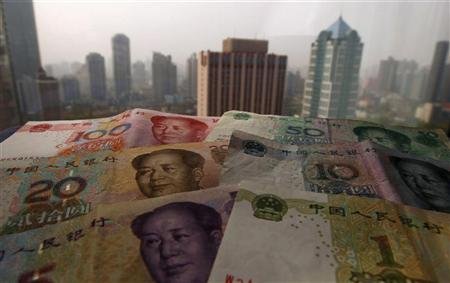
U.S. Treasury says China yuan move helpful


WASHINGTON (Reuters) - The U.S. Treasury Department said on Sunday that a wider yuan trading band could help reduce global trade imbalances if it allows more play for market forces.
"China's decision to widen the daily trading band for its exchange rate, if implemented in a way that allows the value of the exchange rate to reflect market forces, could contribute rebalancing, which would be positive for China, the United States, and the global economy," a Treasury Department official told Reuters.

But the Treasury said the process of correcting a "misalignment" of China's exchange rate is still incomplete and said more progress was needed.
"While we welcome the progress to date, the process of correcting the misalignment of China's exchange rate remains incomplete, and further progress is needed," the Treasury said.
U.S. manufacturers complain that China's yuan is so undervalued that it gives Beijing an unfair trading advantage and they blame it for having cost millions of lost American factory jobs.
The Treasury announced on Friday that a semi-annual report to Congress on currency practices of major trading partners, including China, that was due on April 15 was being delayed until after a series of upcoming international meetings.
(Reporting by Glenn Somerville; Editing by Sandra Maler)

Embarrassed by rocket crash, North Korea may try nuclear test


PYONGYANG/SEOUL (Reuters) - North Korea said its much hyped long-range rocket launch failed on Friday, in a very rare and embarrassing public admission of failure by the hermit state and a blow for its new young leader who faces international outrage over the attempt.
The isolated North, using the launch to celebrate the 100th birthday of the dead founding president Kim Il-sung and to mark the rise to power of his grandson Kim Jong-un, is now widely expected to press ahead with its third nuclear test to show its military strength.

"The possibility of an additional long-range rocket launch or a nuclear test, as well as a military provocation to strengthen internal solidarity is very high," a senior South Korean defense ministry official told a parliamentary hearing.
The two Koreas are divided by the world's most militarized border and remain technically at war after an armistice ended the Korean War in 1953.
The United States and Japan said the rocket, which they claimed was a disguised missile test and the North said was to put a satellite into orbit, crashed into the sea after travelling a much shorter distance than a previous North Korean launch.
Its failure raises questions over the impoverished North's reclusive leadership which has one of the world's largest standing armies but cannot feed its people without outside aid, largely from its only powerful backer, China.
"(There is) no question that the failed launch turns speculation toward the ramifications for the leadership in Pyongyang: a fireworks display gone bad on the biggest day of the year," said Scott Snyder of the Council on Foreign Relations.
In a highly unusual move, the North, which still claims success with a 2009 satellite that others say failed, admitted in a state television broadcast seen by its 23 million people that the latest satellite had not made it into orbit.
The failure is the first major and very public challenge for the third of the Kim dynasty to rule North Korea just months into the leadership of a man believed to be in his late 20s.
"It could be indication of subtle change in the North Korean leadership in how they handle these things, something that may be different from the past," said Baek Seung-joo of the Korea Institute of Defense Analyses a thinktank affiliated with South Korean Defence Ministry.
"I mean it would have been unthinkable for them to admit this kind of failure in the past, something that could be seen as an international humiliation. The decision to have come out with the admission had to come from Kim Jong-un."
Embarrassingly, the rocket flew for just a few minutes covering a little over 100km to explode over a sea separating the Korean peninsula and China, far less than the last rocket in 2009 that travelled 3,800km, alarming Japan which it over-flew.
The launch is in breach of United Nations Security Council sanctions and drew condemnation from the United States, Russia, South Korea and Japan.
But North Korea looks to have avoided the threat of fresh U.N. sanctions - which neighbor Japan is pushing for - after Russian Foreign Minister Sergei Lavrov said that at talks with his Chinese and Indian counterparts they had agreed new sanctions would do nothing to help resolve the situation.
Regional powers are worried that the North is using launches to perfect technology to enable it to build a missile capable of delivering a nuclear warhead to the United States.
North Korea has repeatedly defended its right to launch rockets for what it says are peaceful purposes and may have invested hundreds of millions of dollars in the failed launch.
China, the North's main backer, again appealed for "calm", although its failure to dissuade Pyongyang from undertaking the launch despite propping up the ailing and impoverished state, showed the limitations of its diplomacy, analysts said.
"North Korea's provocative action threatens regional security, violates international law and contravenes its own recent commitments," White House spokesman Jay Carney said.
The North American Aerospace Defense Command, NORAD, said the first stage fell into the sea west of South Korea, and the remainder was deemed to have failed.
"No debris fell on land," NORAD said. "At no time were the missile or the resultant debris a threat."
CHINA HOLDS KEY DESPITE DIPLOMATIC FAILURE
The launch came just weeks after a "Leap Year" deal that saw Washington agree to provide food aid. Among the promises Pyongyang made in return was not to launch any long range rocket or undertake nuclear tests.
There is likely to be pressure from leading countries to impose more sanctions on the North. But it poses difficulties for China which will likely resist further sanctions even though its own diplomacy failed to stop the rocket launch.
"After giving so much aid to North Korea, it still did not listen to China, and this hurt China-North Korea relations and erodes domestic support in its continued support of North Korea," said Shen Dingli, a professor and regional security expert at Shanghai's Fudan University.
"This also undermines confidence in the U.S.-China relationship, and whether China had done enough to persuade the North. So, China is also a loser, but not as big a loser as if North Korea succeeded in its launch," he said.
If the United States, Japan and South Korea do ratchet up pressure on North Korea that could lead to a show of defiance from the North such as a nuclear test, or an attack like the one in 2010 that saw it shell a South Korean island, killing civilians.
"Rather than any conventional provocation, I think North Korea will watch what U.S. and South Korea are doing and prepare for a nuclear test," said Chung Young-chul, a professor at Sogang University's Graduate School of Public Policy. 
PRICE OF FAILURE FOR "SUPREME COMMANDER"    
Now led by Kim Jong-un, North Korea had planned to make 2012 the year in which it became a "strong and prosperous nation" and the launch was part of a program to burnish its credentials. It even, unusually, invited foreign media in to cover the birthday celebrations and showed them the launch site.Kim was named First Secretary of the Workers Party of Korea earlier this week and on Friday as head of the National Defence Commission, as he accumulates titles and posts similar to those held by his father, Kim Jong-il who died in December.
State newspaper Rodong Sinmun on Friday dubbed him "the sun whom all the party members, service personnel and people of the DPRK (Democratic Peoples Republic of Korea) acclaimed out of their heartfelt desire."
Although North Korea is one of the most tightly controlled states on earth, with no free media and a tight grip on its population, such a high profile failure could trigger a backlash among the country's elite.
"This is the first crisis for the new leader that has just taken over," said Lee Jong-won, a professor at Waseda University in Tokyo.
"It is inevitable that they will look to find who is responsible for the failure, and I wonder what the treatment will be for those in the military and the hard-line officers who have pressed for the launch."
(Additional reporting by Yoko Kubota and Nobuhiro Kubo in TOKYO,; Jack Kim in SEOUL, Jeff Mason and Paul Eckert in WASHINGTON, Michael Martina in BEIJING; Writing by David Chance, Editing by Raju Gopalakrishnan and Jonathan Thatcher)

Call for Friday protests is first test of Syria truce


BEIRUT (Reuters) - Syrian opposition activists called mass protests for Friday to test a fragile, day-old ceasefire by President Bashar al-Assad's forces, and international pressure mounted forDamascus to fully comply with a U.N.-backed peace plan.
Anxious to build on a truce between the armed forces and rebels which brought an eerie calm to Syria on Thursday, after more than a year of clashes, the U.N. Security Council worked on a resolution authorizing U.N. observers to monitor it.

World leaders welcomed the halt in fighting which had threatened to spill over into neighboring countries and U.N. Secretary General Ban Ki-moon said the situation looked calmer.
"The world is watching, however, with skeptical eyes since many promises previously made by the government of Syria have not been kept," he told a news conference in Geneva.
Along with the withdrawal of forces from population centers, U.N.-Arab League envoy Kofi Annan's six-point plan calls for talks with the opposition aimed at a "political transition", the release of political prisoners, access for humanitarian aid and journalists, and for the authorities to "respect freedom of association and the right to demonstrate peacefully".
Burhan Ghalioun, head of the opposition Syrian National Council (SNC), said he did not trust the authorities to allow the renewal of protests after Friday prayers, a feature of the uprising that has been subdued by violence in recent months.
The authorities, he said, had their "hand on the trigger".
"While we call on the Syrian people to protest strongly... we ask them to be cautious because the regime will not respect the ceasefire and will shoot," he told Reuters.
AUTHORISED PROTESTS
The Syrian Interior Ministry said only pre-authorized demonstrations would be permitted by police, a caveat which the opposition said did not bode well.
"This is ridiculous," said an activist called Musab from Hama city, a focus of opposition activity and government bombardment along with Homs and Idlib. "They will not give you permission and you will be taken to jail if you ask for it".
He said a demonstration on Wednesday in the town of Qalat Madiq, in Hama province, had been broken up by security forces firing, and nine people were arrested. Most independent media are banned from Syria, making such reports impossible to verify.
In Homs, where opposition stronghold districts were all but deserted, activist Yazan expressed doubt people would dare to go out because snipers, tanks and soldiers were still in place. "People are wary and they believe that this ceasefire is only temporary. Nobody is leaving their homes," he said.
The SNC's spokesman said Assad could simply not afford to stop shooting, since that would allow a new wave of mass protests against his family's four decades of absolute power.
"As soon as there is a real ceasefire, people will come out to the streets, demonstrating and demanding his removal, his stepping down. So I think the regime has to retaliate by opening fire again," spokesman Bassam Imadi told Reuters in Istanbul. "But let's hope for the better."
OBERVER DEPLOYMENT
Annan, mandated by the United Nations and Arab League, has called for 200 to 250 unarmed U.N. observers to monitor the ceasefire.
A similar Arab League mission ended in disarray amid mounting violence in January, but Russia's U.N. Ambassador Vitaly Churkin said the 15-member Security Council could adopt a resolution authorizing the deployment of a U.N. observer force as early as Friday.
"The full-fledged mission will take some time to deploy ... If we are able to put 20 or 30 monitors (there) early next week, very good," Churkin said. "If we are able to put more in the next few days that's even better."
A draft resolution drawn up by the United States would have the Council authorize an initial deployment of up to 30 observers and demand the withdrawal of troops and heavy weapons from population centers and an end to violence on all sides.
It included a vague threat of future action against Damascus, saying the council "expresses its determination, in the event that the Syrian government does not implement its commitments, to consider further measures as appropriate".
It was not immediately clear how Russia and China, which vetoed two previous resolutions condemning Assad's 13-month assault on anti-government protesters, reacted to the draft, which diplomats discussed behind closed doors on Thursday.
Most of the demands in it were addressed to the Syrian government, which could irritate Moscow and Beijing. Both have welcomed the ceasefire while emphasizing the requirement for rebel forces to comply.
The United States and European Union have imposed their own sanctions against Damascus after failing to persuade Russia and China to join in.
Moscow and Beijing are wary of further U.N. moves, alarmed by the way last year's Security Council resolution on Libya led to military intervention, though Western leaders are also cautious about intervening in Syria's mix of religious and ethnic groups.
Ban said there had been a surge in Syrian refugees fleeing to Turkey and Lebanon this week and an estimated 1 million people inside Syria now needed humanitarian assistance.
He was urging Assad to keep his promise and to exercise maximum restraint, he said.
"This ceasefire process is very fragile - it may be broken any time if, and when, there is another gunshot," Ban said. "This is a very worrisome."
(Additional reporting by Louis Charbonneau and Michelle Nichols at the United Nations, Stephanie Nebehay and Tom Miles in Geneva, Oliver Holmes and Douglas Hamilton in Beirut, Michael Holden in London and Balazs Koranyi in Oslo; writing by Philippa Fletcher; editing by Jon Boyle)

Jobless claims cast cloud on labor market


WASHINGTON (Reuters) - The number of Americans filing for jobless aid hit a two-month high last week and more applications were received in the prior week than initially reported, suggesting a cooling in the labor market recovery.
Initial claims for state unemployment benefits increased 13,000 last week to a seasonally adjusted 380,000, the Labor Departmentsaid on Thursday, defying economists' expectations of a drop to 355,000. The prior week's count was revised to show 10,000 more applications than previously reported.

While economists cautioned against reading too much into the report, saying problems adjusting the data for seasonal fluctuations around Easter may have pushed last week's figure higher, they said it nonetheless provided a worrying signal.
"It certainly bolsters the view that things are starting to slow down," said Tim Quinlan, an economist at Wells Fargo Securities inCharlotte, North Carolina.
The data comes in the wake of a report on Friday that showed the economy created only 120,000 jobs last month, the fewest since October. The unemployment rate fell to a three-year low of 8.2 percent, but largely as people gave up the search for work.
Economists noted that initial claims tend to be volatile at this time of year due to shifts in the timing of Easter and school spring breaks, making it difficult for the Labor Department to adjust the data for seasonal variations.
Claims have risen in nine of the last 11 Easter holiday weeks and have over the past year tended to increase in the first full week of a quarter.
"We're also getting some payback for a mild winter. Mild temperatures kept construction workers on the payrolls and that is causing some issues with the seasonal adjustment as well," said Ryan Sweet, a senior economist at Moody's Analytics in West Chester, Pennsylvania.
"The increase caught our attention, but the next few weeks will be very telling. If claims continue to tick higher then it will be a signal that the sword over the jobs market is real. For now we take this report with a grain of salt."
The four-week moving average for new claims, considered a better measure of labor market trends, rose moderately.
TRADE GAP NARROWS SHARPLY
Stocks on Wall Street ended more than 1 percent higher as investors focused on a decline in yields of some euro zone government bonds and hopes that China will report strong first-quarter growth on Friday.
U.S. Treasury debt prices lost some of their safe-haven appeal and fell, while the dollar weakened broadly.
Away from the labor market, there was some good news for the U.S. economy.
A report from the Commerce Department showed the nation's trade gap shrank 12.4 percent to $46 billion in February as exports hit a record high. It was the biggest month-to-month decline in the trade shortfall since May 2009.
The shrinking of the deficit prompted economists, including those at Goldman Sachs, to lift their estimates for first-quarter economic growth. Goldman Sachs now see U.S. gross domestic product expanding at a 2.5 percent annual pace instead of 2.3 percent estimated previously.
The economy grew at a 3 percent rate in the fourth quarter.
A third report showed little sign of inflation pressures. The Labor Department said prices received by U.S. producers were unchanged in March after advancing 0.4 percent in February, while wholesale prices excluding volatile food and energy costs rose 0.3 percent.
That should allow the Federal Reserve to keep interest rates ultra low and even embark on a third round of asset purchases, or quantitative easing, should job growth completely stall.
New York Federal Reserve Bank President William Dudley said on Thursday the U.S. central bank was gathering more data to determine whether last month's weak employment report was just a weather-related setback or a sign the recovery is losing momentum again.
"The somewhat softer March labor market report that was released last Friday may reflect the earlier positive influence of the mild weather on job creation in January and February, although other less-sanguine interpretations are also plausible," he said.
Last month, over one-third of the rise in the core Producer Price Index was attributed to rising costs for light trucks. Higher prices for passenger cars, soaps and detergents also contributed to the advance.
In the 12 months through March, wholesale prices rose 2.8 percent, the smallest increase since June 2010, after advancing 3.3 percent in February.
"Price pressures have eased but are not gone because of recession in Europe and slowing output growth in China," said Michael Montgomery, a U.S. economist at IHS Global Insight in Lexington, Massachusetts.
(Additional reporting by Doug Palmer; Editing by Dan Grebler)

Global cyber arms race engulfing Web - Defense official


WASHINGTON (Reuters) - A global cyber arms race is engulfing the Internet and the best way to counter the rapidly escalating threat is combining the efforts of U.S. agencies, private firms andinternational alliescyber security officials said on Tuesday.
Cyber experts from across the U.S. government, speaking at a conference at Georgetown University, said organized crime, espionage and security activity on the Internet pose a rising threat to U.S. intellectual property, military superiority and critical infrastructure.

"What we're looking at is a global cyber arms race," said Rear Admiral Samuel Cox, director of intelligence at U.S. Cyber Command, which was set up 18 months ago to protect Pentagon computer networks and conduct offensive cyber operations if the president orders them.
"It's not proceeding at a leisurely or even a linear fashion but in fact is accelerating. I wouldn't claim that it's following Moore's law, but the curve looks kind of similar," he said, referring to a computer industry rule of thumb that computer processing power doubles every couple of years.
Howard Schmidt, cyber security coordinator at the White House, said more than $8 trillion worth of transactions were carried over wired and wireless networks each year.
"This is not just a national security issue," he told the conference. "It's a national security, public safety as well as economic."
Officials said the most effective way to counter the threat is to adopt an approach that promotes collaboration among government agencies and reaches out to private industry as well as international partners.
TEAM SPORT
"To really operate effectively in cyberspace ... it's really a team sport," said Steven Schleien, the principal director for cyber policy at the Pentagon.
That's why the Defense Department has been working with private companies and allies like NATO, Japan and South Korea to discuss information sharing and coordinated responses to incidents on the Internet, he said.
NATO wants to bring all of the civilian and military networks in the organization under the wing of the NATO Computer Incident Response Capability by the end of 2012, which would allow a coordinated response to cyber attacks.
The United States has begun discussions on cyber security with Japan, South Korea and New Zealand, and is working closely with the Britain and Australia on a "full spectrum" of cooperation in cyberspace, Schleien said.
The United States does not view arms control treaties as a means of dealing with the problem but would like to see the international community agree on norms of behavior for cyberspace, he said.
"This is not an area where arms control works. I don't know what we would monitor. I don't know how we would verify anything in terms of cyber weapons or cyber tools," Schleien said.
Discussions on norms of behavior would begin to address the issue of how to fight proxies who carry out Internet attacks on behalf of governments, and "hactivists," who attack computer networks for their own political ends.
"How do you deal with hactivists from your soil?" Schleien asked. "Are you responsible as a sovereign nation for what comes out of your country?"
The issues are sensitive and complex. A U.S. nonprofit group, for example, concluded Russian civilians acting with advance notice of Russian military intentions carried out cyber attacks in the 2008 Russia-Georgia conflict.
Some websites used to organize those attacks were hosted in the United States.
(Reporting By David Alexander; Editing by Xavier Briand)

China, between a rocket and a hard place on North Korea


BEIJING (Reuters) - A joke circulating among officials in Beijingpretty much underlines the bind China is in over North Korea's plans to send a satellite into space.
North Korea's young ruler Kim Jong-un phones a Chinese leader to tell him about timing of the planned rocket launch. "When will it be?" asks the Chinese leader.

Kim replies: "Ten, nine, eight, seven, six, five, four..."
Beijing has received more notice than that - the launch is likely later this week - but a source close to China's top leadership and a Western diplomat have both said it nevertheless has little influence over Pyongyang and is in no position to block the event.
The United States, which has said the launch will give the unpredictable state an opportunity to test ballistic missile technology, wants Beijing to use its influence to halt the lift-off.
"China has pressured North Korea to abandon (the launch) because it adds new variables and gives the United States an excuse to return to Asia," the source with ties to the leadership told Reuters, requesting anonymity to avoid repercussions.
"China does not want to see this because Beijing and Shanghai are within range" of North Korean ballistic missiles, he said, referring to China's political and financial capitals and providing further evidence that Beijing does not have fully warm and friendly ties with its unpredictable neighbor.
Critics however are convinced China, the main provider of food and energy aid to its isolated neighbor, could do more to force North Korea to scrap the launch.
Last month U.S. President Barack Obama urged China to use its influence over North Korea instead of "turning a blind eye", and warned of tighter sanctions if the reclusive state presses ahead with the launch.
On Monday, U.S. State Department spokeswoman Victoria Nuland said there were signs that North Korea may also be preparing for a nuclear test, its third.
"We believe in particular that China joins us in its interest in seeing a denuclearized Korean peninsula, and we are continuing to encourage China in particular to act more effectively in that interest" she said.
Nuland told reporters a third North Korean nuclear test "would be equally bad if not worse" than the rocket launch.
It would be in the interests of both China and North Korea at this juncture to say Beijing has little influence over Pyongyang.
But the countries have maintained warm relations despite tensions in recent years. Before his death last year, North Korean leader Kim Jong-il visited China four times between May 2010 and August 2011. His son Kim Jong-un, who is now leader of the autocratic state, is believed to have accompanied him on at least one of this trips.
The rocket that North Korea has readied for launch from a forested valley in its remote northwest will showcase its ability to fire a missile capable of hitting the continental United States.
Pyongyang insists the weather satellite launch will be a milestone to mark the 100th birth anniversary of Kim Jong-un's grandfather, North Korea's founder Kim Il-sung, and backing down now would be seen as sign of weakness at home. Nonetheless, Washington and Seoul suspect it is a ballistic missiletest.
"They can't launch the thing without using ballistic missile technology which is precluded by U.N. Security Council Resolution 1874," said Nuland, the U.S. spokeswoman. "So regardless of what they say about it, it's still a violation."
But sending rockets skyward to mark momentous events is a tradition shared by the Communist leaders of both China and North Korea. Having launched satellites in 1982 and 1987 to mark the death anniversary of Mao Zedong and in 1992, 1997, 2002 and 2007 to coincide with Communist Party congresses, China is finding it difficult to convince North Korea to back down.
COMING-OUT PARTY
Pyongyang's move, analysts say, is also aimed at further consolidating the power of Kim Jong-un, believed to be in his late 20s, who became the third member of his family to rule North Korea after his father's death last December.
"If Kim No. 3 requires a symbol of his authority, that rocket launch might be that symbol tied to the legitimacy of the (ruling) Korean Workers' Party," the Western diplomat said.
That authority could be challenged if China were to pressure Pyongyang over the rocket launch at this juncture. And Beijing does not want any instability that could arise from a weakened Kim Jong-un.
But the real issue may China's willingness to exercise influence rather than its ability to do so.
"The question is not if China has or doesn't have leverage to pressure Pyongyang. The question is whether it wants to exercise that pressure," South Korean political commentator Shim Jae Hoon said. "Any sign of displeasure shown by China at this time will not fail to have an impact on Kim Jong-un."
And in the end, China sees some value in the North Korean regime as a buffer against South Korea-U.S. military alliance.
"The worst case scenario troubling Beijing is the prospect of a democratic, capitalist South Korea reunifying the whole peninsula. China thinks this will bring U.S. military presence close to its border," Shim said.
China is caught between a rock and a hard place.
"It's troublesome. North Korea is difficult to control. We have no choice but to help them" by continuing to provide aid, the source with leadership ties said, adding that squeezing Beijing's food and energy lifeline to Pyongyang could lead to an exodus of North Korean refugees destabilizing China's northeast.
China's relationship with North Korea was once characterized to be "as close as lips and teeth" after they fought side-by-side against the United States and South Korea during the 1950-53 Korean War. But the two strayed apart after Beijing flirted with capitalist-style reforms -- seen by Pyongyang as a betrayal -- and recognized Seoul in 1992.
Deng Xiaoping, China's late leader, once quipped that dynastic succession is not a Communist tradition, riling Kim Jong-il who was poised to take over from his father, sources familiar with China's foreign policy said.
China takes great pride in transforming itself into an economic powerhouse from a backwater after just three decades of reform and is growing increasingly impatient with what it sees as an incompetent North Korean leadership which cannot feed its own people, the sources said.
"Our relationship with North Korea is no longer 'If the lips are gone, the teeth will be cold'," a second source with leadership ties said, quoting a Chinese idiom. "Nowadays, the teeth keep biting the lips, and it's hurting."
(Editing by Raju Gopalakrishnan and Don Durfee)

Marine who criticized Obama on Facebook should be dismissed: panel


SAN DIEGO (Reuters) - A Marine who posted on Facebook that he would not follow orders from President Barack Obama should be dismissed from the military with a less-than-honorable discharge, aMarine Corps review board ruled.
Gary Stein, 26, did not comment on the ruling issued late Thursday, one day after his lawyers unsuccessfully sought to delay the review board by seeking an injunction in federal court in San Diego.

The Marines' recommendation to administratively discharge Stein came after a 13-hour hearing and an hour of deliberation by the panel. It will be submitted to Brigadier General Daniel Yoo, the commanding general of the Marine Corps Recruiting Depot, where Stein is stationed.
Yoo has not said what action he plans to take, if any. He is expected to make a decision within 30 days, according to Major Mike Armistead, a Marine Corps spokesman.
Any discharge from the military that is not honorable can mean the loss of benefits available to most U.S. military veterans.
Stein, who is a meteorologist at Camp Pendleton, served nearly nine years, including a tour of duty in Iraq. He was due to either re-enlist or end his enlistment at the end of July, according to court documents.
Stein had posted comments saying he would refuse to obey orders from the president, who is the commander-in-chief of the military, on a Facebook page called the Armed Forces Tea Party page.
He later removed the comments and said he meant only unlawful orders. In 2010, he got in similar trouble with the Marine Corps and was advised to post a disclaimer that the Armed Forces Tea Partyis not affiliated with the Armed Forces.
He also posted comments to a Facebook network called METOC, which is limited to active duty meteorologists and oceanographers, where he described Obama as an enemy to America. Those comments were the basis for some of the allegations reviewed by the board.
Marines and all other military members swear an oath to defend the Constitution of the United States as well as to follow the Uniform Code of Military Justice, which restricts political activities while in uniform. Off-duty, out-of-uniform actions are far less restricted, but there are limits.
A coalition of attorneys support Stein, saying in a written statement that the First Amendment guarantees his freedom of speech.
(Editing by Greg McCune and Stacey Joyce)